
How to Write a True Enemies to Lovers Romance
Updated: Sep 9

Enemies to lovers is one of the most popular tropes in romance. To write and market it effectively, you need to understand what makes this trope work – and why readers love it so much.
In this post, I’ll break down what makes (and breaks) a true enemies-to-lovers romance.
I’ll be using two books as examples: The Crimson Moth by Kristen Ciccarelli and Enemies with Benefits by Roxie Noir. I will reveal as little as possible, but feel free to skip the example sections if you still want to read them yourself. (You should!)
Why Is This Trope So Popular?
One of the biggest appeals is the potential for growth for the characters. We’re not only watching love develop – we’re watching characters change. As they uncover new layers of each other, their perceptions shift, and attraction builds. True enemies challenge each other through external conflict, as well as through clashing values, fears, and worldviews, which builds tension, angst, and emotional depth. (Which can also lead to great banter!)
They often see each other at their worst and fall in love anyway. That’s what makes the payoff so satisfying – especially when their feelings for each other could cost them everything. As readers, we’re rooting for the romance and the resolution of the conflict that keeps them apart.
An enemies-to-lovers romance naturally unfolds as a slow burn, with gradually building tension, pining, and yearning that keep readers engaged page after page. (And who doesn’t love a good slow burn?)
How to Pull It Off
01 Make them true enemies
Your characters need to be genuine enemies. Not haters, rivals, or bullies – enemies. Fantasy lends itself well to this, as your worldbuilding can create a strong, believable conflict, but this trope works just as well in contemporary, historical, or dystopian settings (think spies, military, war, etc.).
02 Give them a good reason to interact
Your (not-yet) lovebirds need a compelling reason to spend time together despite being on opposing sides. Forced proximity or temporary shared goals can work well here.
03 Build attraction gradually
They shouldn’t fall for each other immediately. They might notice small details such as a glance, a rare smile, or a jawline, but the attraction should stay subtle at first and grow over time, both physically and emotionally.
04 Develop trust and respect
As the story progresses, they begin to find common ground. Walls come down between them, trust starts to grow, and respect follows, sometimes even leading to friendship, before love fully takes shape.
05 Love at a cost
Their affection for each other has to cost them something, forcing them to question their upbringing, beliefs, or even their very self. The stronger their feelings grow, the harder it becomes to hold onto what they once believed.
Common Pitfalls
Switching too quickly from enemies to lovers
Introducing attraction too early or too strongly
Stakes not high enough for one or both characters
Letting only one character grow or change
Making one or both characters irredeemably cruel or disrespectful towards each other
(unless you’re intentionally writing something very dark; tread with caution)
Example: The Crimson Moth
In The Crimson Moth, Rune is suspected of being a witch, and Gideon – a witch hunter – is determined to uncover the truth. So what do they do? They start fake-dating (yes, another trope woven in) as a way to stay ahead in the hunt. But over time, they slowly fall for each other.
If you ask me, The Crimson Moth is an exceptional example of this trope done well. The stakes are high for both characters, their attraction grows slowly, and just when you think you know where the story is going, Ciccarelli throws in another twist.
Example: Enemies with Benefits
Disclaimer: I absolutely enjoyed this book. But... they’re not really enemies. It leans more towards rivals- or competitors-to-lovers, and even then, Violet and Eli team up relatively quickly. Eli is a chef and Violet an event manager. Granted, they work at the same venue, but relatively speaking, the stakes are quite low for them. Interestingly enough, ‘rivals to lovers’ is exactly how the book is described on Amazon:
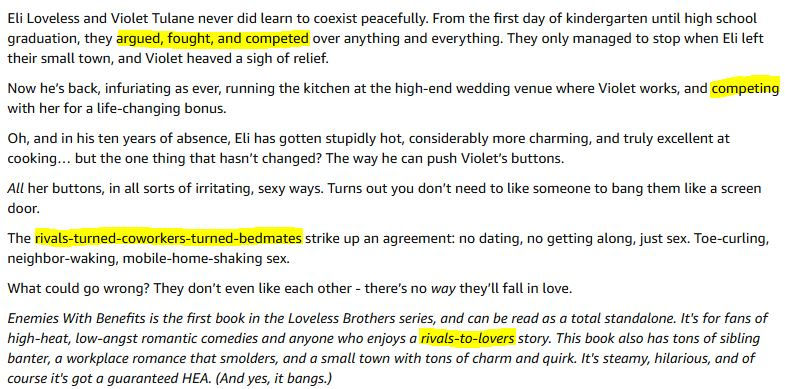
Blurb-wise, the reader is well prepared for what to expect. The title and categorisation, however, may still feel misleading to some (plus, not everyone reads blurbs *raises hand*).
Many readers on Goodreads loved the story and writing enough to overlook the lack of ‘true enemies,’ though not all did – some lowered their rating or left a negative review because of it.
The Risk of Enemies to Lovers
The ‘problem’ with Enemies with Benefits, and any other romance without ‘true’ enemies, is that the term ‘enemies to lovers’ covers such a wide spectrum. For example, even Pride and Prejudice falls under it.
However, in recent years, I’ve seen reader expectations shift slightly. If a book is labelled enemies to lovers, readers increasingly expect real opposition on the page: serious conflict, high stakes – not just dislike, rivalry, or a shared history that no longer carries weight in the present story. From my observation, this is especially true in Fantasy Romance/Romantasy.
Romance readers know exactly what they want (and what they don’t), so it’s worth being mindful of how you present your story to them (for example, in social media mock-ups) if your characters aren’t truly enemies. If your trope doesn’t deliver what it promises, readers may end up feeling disappointed. This can lead to negative reviews or damage trust with readers. Once you break that trust, it can be very difficult to get it back – if you ever do.
Don’t get me wrong; my point is not that Enemies with Benefits, Pride and Prejudice, or similar romances are poorly received. (Overall, the reviews are still very positive.) Rather, not every author can rely on readers overlooking a gap between how a trope is labelled and how it is interpreted, especially with a debut romance or when every review matters. This is where tropes such as rivals to lovers or haters to lovers come into play. You may still appeal to a large proportion of ‘true’ enemies-to-lovers readers, but they are less likely to feel ‘misled.’
My job as a romance editor is to make you aware of genre and reader expectations, so you can make informed decisions.
If you’re unsure whether your story delivers on its tropes, I can help you refine your romance so it connects with the right readers and expectations. You can find more details about my editing services here.


Comments